Magnetic Catches & Closures
Door catches and magnetic closures. Pull force is written at the working gap against the steel counterpart — not in free space.
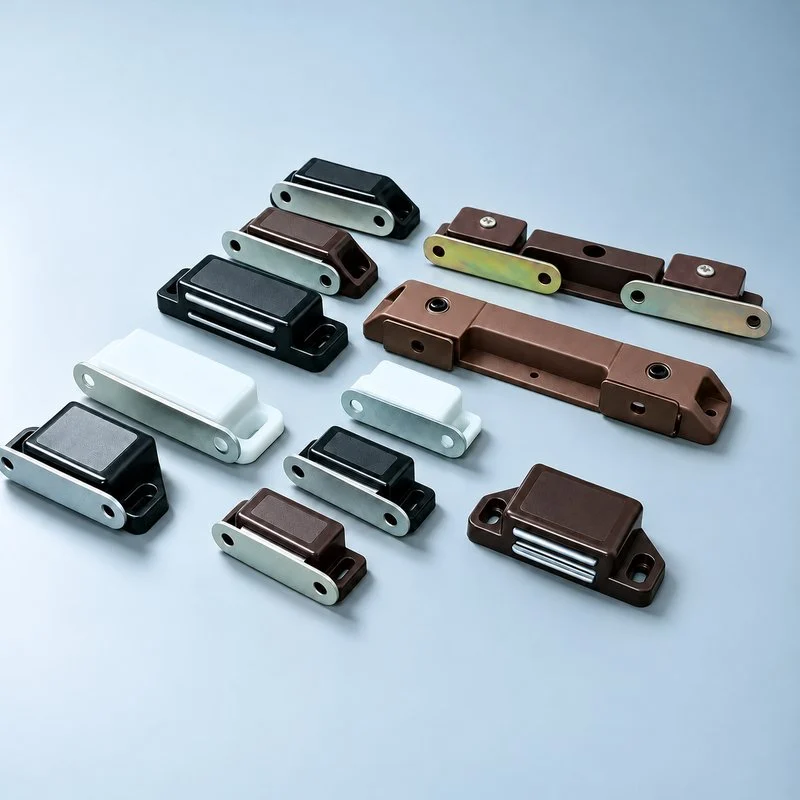
Applications in This Family
More specific application profiles, each with its own requirements, magnet forms and selection notes.
Door Catches
Magnetic door catches and door stops: pull force at the working gap, and a mounting that survives the door's closing impact.
Catches and closures are where the magnet is asked to hold rather than to rotate: a door catch pulling a steel plate shut, a curtain tieback closing around the fabric, a latch keeping a cabinet or an access panel closed. The magnet is never the whole mechanism — it is one half of a magnetic circuit whose other half is the steel counterpart it pulls against, and whose working distance is the small air gap between them. That gap is what the specification has to be written around.
Pull force is written at the gap, not in free space
A magnet quoted in free space does not describe a catch, because a catch works across a gap. Pull force rises steeply as the gap closes and falls steeply as it opens, so the useful number is the force the catch must hold at the gap it actually sees, against the steel part it actually pulls. Stating that number — the required pull at the working gap, against the counterpart — is what turns a vague request into a magnet that can be specified.
- The pull force depends on the magnet, the steel counterpart, the gap and the contact area together, so it is a circuit value confirmed per project, not a number read off a magnet on its own.
- A steel cup or pot concentrates the flux on one face and shortens the circuit, which is why catch magnets are so often pot magnets rather than bare blocks.
The magnet is brittle, the mounting is not optional
Ferrite in particular is a ceramic: it holds a useful field cheaply, but it chips and cracks under impact, and a door catch takes impact every time the door closes. The standard answer is to carry the magnet in a steel cup or housing that both concentrates the flux and takes the mechanical load, so the magnet itself never meets the strike plate. Mounting is therefore not an afterthought — it is part of the magnetic and mechanical design at the same time.
Corrosion follows the room, not the magnet
A curtain tieback in a bathroom, or a catch on an exterior gate, sits in humidity that a catch on an interior door does not. Sintered ferrite is normally supplied uncoated and is generally corrosion-resistant; NdFeB needs a protective coating, and that coating is selected against the actual exposure. Whether an uncoated part is acceptable is confirmed for the project against where the part lives.
Where the material choice lands
Catches and closures sit almost entirely on one of two answers. Where the volume allows it and the pull requirement is modest, strontium ferrite does the job uncoated and at the lowest cost. Where the same pull has to come out of a smaller envelope, or the catch must feel firm across a wider gap, sintered NdFeB delivers several times the flux in the same volume, at a higher material cost and with surface protection that is mandatory. The decision is a pull-at-the-gap and volume question, confirmed per project.
Recommended forms
Pot and cup magnets with a steel shell are the established form for catches, latches and closures; bare ferrite blocks and discs suit assemblies where the customer’s own housing carries the load. Sintered NdFeB discs or blocks in a cup cover the higher-pull, smaller-envelope cases. In every case the form follows the mounting and the pull target rather than the other way round.
Key Electromagnetic & Mechanical Requirements
The magnet requirements this application imposes, and what to send us for a first assessment.
Holding / Pull Force
The pull force the catch must hold at its working gap, against the steel counterpart it pulls.
Pull force is a circuit value, not a magnet value alone: the magnet, the counterpart, the gap and the contact area set it together, so it is confirmed per project.
Corrosion Resistance
Whether the part sits in a humid or outdoor position, and whether uncoated ferrite or a plated NdFeB is needed.
Sintered ferrite is generally supplied uncoated and corrosion-resistant; NdFeB needs a coating selected against the actual exposure, confirmed for the project.
Mounting & Impact Survival
How the magnet is retained — cup, countersunk bore or press fit — so the brittle magnet never takes the closing impact.
The steel cup or housing both concentrates the flux and carries the mechanical load; mounting and magnetic design are one decision.
Common Engineering Challenges
The magnet is only half the circuit, and the easy mistakes are on the other half: pull force quoted in free space instead of at the working gap, a bare brittle magnet asked to take a door's closing impact, and a ferrite part specified where the volume demands NdFeB — or the reverse, an NdFeB over-specified where ferrite would close the requirement. Corrosion is the third pressure point where the catch lives in a bathroom or outdoors, and the choice of uncoated ferrite against a plated NdFeB follows the exposure rather than the shape.
Engineering Selection Notes
Start from the pull force the catch must hold at its working gap, against its steel counterpart, and state the gap and the counterpart rather than a free-space number. Ferrite closes the requirement where the volume and the pull allow it, supplied uncoated at the lowest cost; NdFeB is the answer where the same pull must come from a smaller envelope, with a mandatory coating selected against the exposure. Choose the mounting at the same time, because the cup or housing that carries the load also sets the magnetic circuit.
Preferred Magnet Grades & Geometries
Pot and cup magnets with a steel shell for catches and latches; bare ferrite blocks and discs where the customer's housing carries the load; sintered NdFeB discs or blocks in a cup for higher pull in a smaller envelope. The form follows the mounting and the pull target, confirmed per project.
Request Quote for This ApplicationStart From These Product Pages
What the Pole Pattern Has to Match
How the magnet is magnetized follows how it works in the machine: the face that faces the air gap, the pole count around that face and the direction the field has to run are read from the assembly, not chosen from a list. If any of that is still open, say so — a sample or a photograph of the existing part is enough to start.
Magnetization feasibility depends on the material, manufacturing process, geometry and required pole pattern. Send us your drawing, sample or magnetization diagram for evaluation.
Magnetization directions and pole patterns explained → · Send the drawing or a sample →
Reviewed by the ProfurtherMag team.