Automotive Auxiliary Systems
Fuel pumps, window lift and seat motors. Strontium ferrite arcs, or plated sintered NdFeB where more flux is needed in less space.
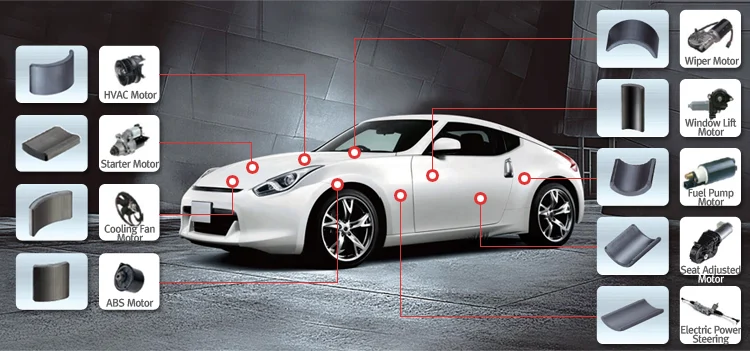
Automotive auxiliary systems — fuel pumps, water booster pumps, window lift motors, seat adjusters and electronic power steering sensor units — sit close to the engine, the fuel system and the road, so the magnet has to survive the environment as well as produce flux. Programs in these positions run to an automotive quality system: where the programme requires certification, the part is produced in a partner factory that holds the certificate, the holder is named to the customer on request, and the condition is agreed per project. The requirements below are what the magnet supply has to deliver inside that framework.
What the delivered parts actually ran into
A requirement list is abstract; the failures are not. Since 2018 we have supplied ferrite arc magnets to an automotive axial fan and blower manufacturer, produced to the customer's own drawings and confirmed by sampling before bulk purchasing. On one axial fan project the end chamfer had to be opened, because one end of the magnet could not reach its seating position at the edge of the plastic clip holder and the U-shaped retaining clip therefore could not engage securely.
Nothing on the magnet drawing was out of tolerance. The assembly rejected the part anyway. That is the characteristic failure mode on this page: not a magnet that misses its grade, but one that meets its drawing and still does not seat, clip or bond the way the assembly needs it to. It is also why samples here are confirmed in the customer's assembly rather than on a bench, and why the mating interfaces — clip, holder, pocket, adhesive line — belong in the review rather than in a later complaint. The fan and blower case documents that adjustment, including the before-and-after fit at the clip holder.
Where the two material families sit
The choice on an auxiliary-system position is usually made by the exposure first and the flux second, and the numbers on the two sides are far apart:
- Strontium ferrite — Br 380–460 mT and (BH)max 27.0–41.8 kJ/m³ across the grades on the hard ferrite table. Normally supplied uncoated, which is why it carries the wet positions: coolant, fuel and salt spray have no coating to attack, and compatibility is checked against the actual fluid rather than assumed from the material name.
- Sintered NdFeB — Br 1020–1470 mT, with the usable window set by the grade series from N up to AH and up to 230 °C at the top of it, per the NdFeB grade table. Surface protection is required, so the finish becomes a qualified process step chosen against the fluid and the assembly — electroplating, polymer coating or another qualified method, assessed per project rather than taken from a default.
Read together, those two lines explain why an automotive auxiliary position is rarely decided by wanting more flux: moving to NdFeB buys roughly two and a half times the flux per unit volume and, in exchange, adds a coating that has to survive the same fluid the ferrite would have ignored. Where the envelope is generous, ferrite wins on exposure; where it is tight, the coating becomes the project's problem to close.
Key Electromagnetic & Mechanical Requirements
The magnet requirements this application imposes, and what to send us for a first assessment.
Harsh Environment Stability
Continuous submersion in engine coolant, fuel, or severe salt-spray atmospheric exposure.
The exposure decides the material route: ferrite is normally supplied uncoated and its compatibility with the actual fluid or chemical exposure is checked; NdFeB is used where more flux is needed in the same space, with corrosion protection selected against the exposure and assembly.
Batch Consistency
Process capability for the running process, agreed with the producing factory per project across mass batches.
Which characteristics are controlled and to what target is agreed with the producing factory, so the capability figure describes the running process rather than a sample lot.
Traceability
For sintered routes, traceability covers the material lot, the sintering furnace lot and the dimensional record. For bonded routes, traceability covers the compound, the raw material and the molding batch.
The traceability scope and the batch records are agreed per project with the producing factory.
Common Engineering Challenges
The environment is the first difficulty: coolant, fuel and salt spray attack the magnet directly, which rules out unprotected NdFeB and makes the coating a qualified process step rather than a cosmetic finish. The second is repeatability, because auxiliary-system volumes are high and the process capability agreed with the producing factory for the part has to be held across mass batches instead of demonstrated on samples. Traceability closes the loop: raw material lots, sintering furnace lot numbers and dimensional records have to be retained so that a deviation can be traced, and that documentation burden falls on the magnet supply as much as on the motor maker. Material compatibility, dimensional stability and retention also have to be validated for the actual coolant, fuel or chemical exposure, and for bonded magnets the binder and insert interfaces are part of that review.
Engineering Selection Notes
Selection here follows the exposure and the thermal duty.
On the ferrite side, strontium ferrite generally offers good corrosion resistance and is normally supplied uncoated. Compatibility is checked against the actual fluid or chemical exposure. Its usable temperature, and whether demagnetization resistance is retained at elevated temperature, is confirmed per project from the grade and the magnetic circuit, which suits hot, wet or salt-spray positions.
Where the envelope is small and flux must be maximized, NdFeB is used in a high-coercivity sintered grade. The working temperature is then not limited by a standard-grade rating but set per project from the grade and the magnetic circuit.
Corrosion protection for sintered NdFeB is selected against the exposure and assembly. Electroplating, polymer coatings or other qualified protection methods are assessed individually.
In both cases the grade is chosen from the working temperature inside the magnetic circuit and the corrosion exposure, and dimensional tolerances and records are specified so that batch consistency and traceability can be demonstrated.
Preferred Magnet Grades & Geometries
Strontium ferrite arc segments on the ferrite side, and plated sintered NdFeB where more flux is needed in a smaller envelope. In both cases the grade follows the drawing, the operating condition and the customer's requirement, and the magnetization pattern is confirmed per project.
Request Quote for This ApplicationDocumented project records solving challenges in this application.
- Ferrite Arc Magnets for Fan & Blower Motors Delivered Project
Ferrite arc magnets to drawing…
What the Pole Pattern Has to Match
How the magnet is magnetized follows how it works in the machine: the face that faces the air gap, the pole count around that face and the direction the field has to run are read from the assembly, not chosen from a list. If any of that is still open, say so — a sample or a photograph of the existing part is enough to start.
Magnetization feasibility depends on the material, manufacturing process, geometry and required pole pattern. Send us your drawing, sample or magnetization diagram for evaluation.
Magnetization directions and pole patterns explained → · Send the drawing or a sample →