Home Appliances & HVAC
Inverter compressor motors, drain pumps and blowers. Grade is chosen against the bill-of-materials cost limit, not the highest flux on the datasheet.
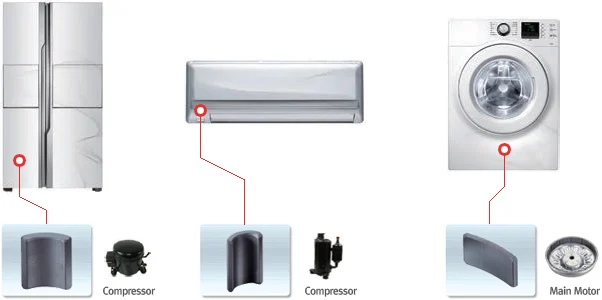
Home appliance and HVAC drives are built in volumes where a few cents of bill-of-materials cost decide the design, and where the motor is expected to stay quiet and stay serviceable for the life of the appliance. Inverter compressor motors, washing machine drain pumps, ventilation blowers and dishwasher circulation systems all depend on the magnet for efficiency, for noise, and for resistance to the humid conditions of a kitchen, a laundry room or a rooftop air handling unit. The three requirements below are what shape the magnet specification in this application.
Cost-to-Performance Ratio
Appliance programs are cost-driven: the magnet has to deliver enough magnetic efficiency for the compressor, pump or blower torque while staying inside a strict bill-of-materials limit, and it has to do so at high volume without a grade change from batch to batch. Magnetic efficiency is therefore maximized inside the cost limit rather than by choosing the highest-energy material available.
- Efficiency is specified as an outcome at the bill-of-materials limit, so the grade is selected against the torque and the cost target rather than from the highest flux on the data sheet, and the grade that fits the duty is confirmed per project.
- The forming route is part of the cost decision: wet-pressed ferrite is chosen where the highest alignment of the ferrite routes is needed, with the Br and Hcj values following the grade and the process; dry pressing is the economical route for simple rings, blocks and discs, and injection molding covers complex shapes and multipole parts.
- Cost stability at volume matters as much as first price.
Acoustic / Vibration Control
Pole-to-pole consistency, pole pitch and the field waveform can influence torque ripple and acoustic excitation. Motor noise also depends on the electromagnetic design, drive control, bearings and mechanical structure. Magnet acceptance criteria are agreed for the project, and noise performance is validated in the customer's assembly.
- Even spacing and even strength around the ring matter more than an individual pole's peak value, because the drive sees the sum of the pattern.
- Axial, diametrical, multipole and radial-oriented multipole magnetization can be produced, and the pattern is confirmed per project against the tooling and the noise target of the drive.
Anti-Oxidation
Appliances live in humid service: condensate in a compressor housing, wash water around a drain pump, outdoor humidity at an air handling unit. Sintered ferrite generally offers good corrosion resistance and is normally supplied uncoated. Compatibility with the actual fluid or chemical exposure is checked for the application.
- Where a design would otherwise need coated NdFeB, coating selection follows the actual exposure; ferrite removes that question where the flux budget allows the volume.
What a delivered appliance magnet actually looked like
The cost argument becomes concrete on a part that ships. The arc segments supplied for a water purifier pump motor yoke — two per steel yoke, repeat orders since 2017, batches shipping as one full 20GP container on 30–35 days — were produced to a drawing of: outer radius R35.5 ±0.1 mm, inner radius R27 +0.2/0 mm, wall 8.5 −0.1/0 mm, section 63 ±0.1 × 40 ±0.5 mm, grade Br 380–400 mT / Hcb 230–275 kA/m / (BH)max 27–32.5 kJ/m³, radial magnetization, supplied uncoated and unmagnetized.
Read that against the cost pressure above. The grade is not the highest the ferrite line can produce — it is the band the drawing fixed, and volume is what makes it economic. The part also ships uncoated and unmagnetized, and both of those take cost out of the route rather than out of the field: no coating to apply or to qualify for a humid position, and no magnetic attraction pulling ferrous debris onto the segments between the factory and the press that fits them into the yoke.
One caution belongs with it. On that program acceptance was settled by the customer fitting two segments into the yoke, not by a magnet measured on its own, because the pair has to close one circumference without a step at the joint. The full case covers the tolerances and that acceptance gate together.
Where the grade window sits
Appliance work sits almost entirely on the ferrite side, and the numbers show why the two families are not interchangeable on cost:
- Strontium ferrite — Br 380–460 mT and (BH)max 27.0–41.8 kJ/m³ across the grades on the hard ferrite table, supplied uncoated. This is where the family wins: the humid service of a laundry room or an air handling unit costs nothing extra, because there is no coating to qualify.
- Sintered NdFeB — Br 1020–1470 mT, series N to AH and up to 230 °C at the top, per the NdFeB grade table. Roughly two and a half times the flux in the same volume, with mandatory surface protection and a material cost that lands directly in the bill of materials.
So the appliance question is not how much flux can be obtained, but how much flux closes the torque requirement inside the envelope the program can afford — and where ferrite fits that envelope, the coating question leaves with it.
Recommended Magnet Forms
Strontium ferrite arcs are the established form here; multipole ferrite rings are a development focus in this application, and the forming route follows the shape and the cost target:
- Strontium ferrite arcs — Wet-pressed ferrite arcs can be evaluated for suitable motor designs.
- Multipole ferrite rings — a development focus in ferrite. A multipole pattern may reduce torque ripple where the motor design allows it; it does not by itself determine acoustic performance. Wet-pressed, dry-pressed or injection molded ferrite covers simple rings as well as complex net-shape rotors; each multipole ring is evaluated per project against the tooling and the noise target.
Key Electromagnetic & Mechanical Requirements
The magnet requirements this application imposes, and what to send us for a first assessment.
Cost-to-Performance Ratio
Maximized magnetic efficiency within strict bill-of-materials cost limits.
The magnet is selected against the bill-of-materials cost, so ferrite's cost stability at volume is weighed against the flux requirement inside the available volume.
Acoustic / Vibration Control
Pole-to-pole consistency, pole pitch and field waveform, agreed as magnet acceptance criteria for the project.
Noise is a whole-machine outcome: magnet acceptance criteria are agreed with the customer and noise performance is validated in the customer's assembly.
Anti-Oxidation
Whether an uncoated part is acceptable: confirmed for the project against the actual exposure.
Whether an uncoated part is acceptable against a given condensate, wash-water or outdoor humidity exposure is confirmed for the project, because that answer decides whether the ferrite route closes the corrosion question or a protected NdFeB route is needed instead.
Common Engineering Challenges
Appliance and HVAC programs are decided on cost at volume, so the magnet is chosen inside a bill-of-materials limit and the temptation to over-specify a high-energy material has to be resisted. Noise is the second pressure point: motor noise depends on the electromagnetic design, drive control, bearings and mechanical structure as well as the magnet, so magnet acceptance criteria are agreed for the project. Humidity is the third: condensate and wash-water exposure make corrosion resistance part of the lifetime expectation, and any design that relies on a coating barrier has to qualify that barrier. All three have to hold at the same time in high-volume production, where batch consistency matters as much as the nominal specification.
Engineering Selection Notes
Selection balances magnetic efficiency against bill-of-materials cost, so the starting point is how much flux the compressor, pump or blower actually needs, not the highest grade available. Ferrite is an option where the flux requirement can be met within the available volume and cost target, and it generally offers good corrosion resistance without being supplied coated. Where a multipole pattern is used, the field is set up as consistently as the tooling allows; the pattern is confirmed per project against the agreed acceptance criteria. Where the design envelope becomes too small for the required torque, NdFeB becomes the alternative, at higher material cost and with surface protection that is mandatory and selected against the actual exposure.
Preferred Magnet Grades & Geometries
Strontium ferrite arcs, and multipole ferrite rings evaluated per project. Arcs are the established form for compressor, pump and blower motors; the ring is a development form offered against a specific project rather than as a catalogue series.
Request Quote for This ApplicationTechnical guides and selection articles for this domain.
- Only Have a Sample? How to Start an Inquiry Buying / Sourcing Guide
No drawing, grade or magnetiza…
What the Pole Pattern Has to Match
How the magnet is magnetized follows how it works in the machine: the face that faces the air gap, the pole count around that face and the direction the field has to run are read from the assembly, not chosen from a list. If any of that is still open, say so — a sample or a photograph of the existing part is enough to start.
Magnetization feasibility depends on the material, manufacturing process, geometry and required pole pattern. Send us your drawing, sample or magnetization diagram for evaluation.
Magnetization directions and pole patterns explained → · Send the drawing or a sample →