Ferrite Arc Magnets for Water Pump Yokes
Project Starting Point: Drawing
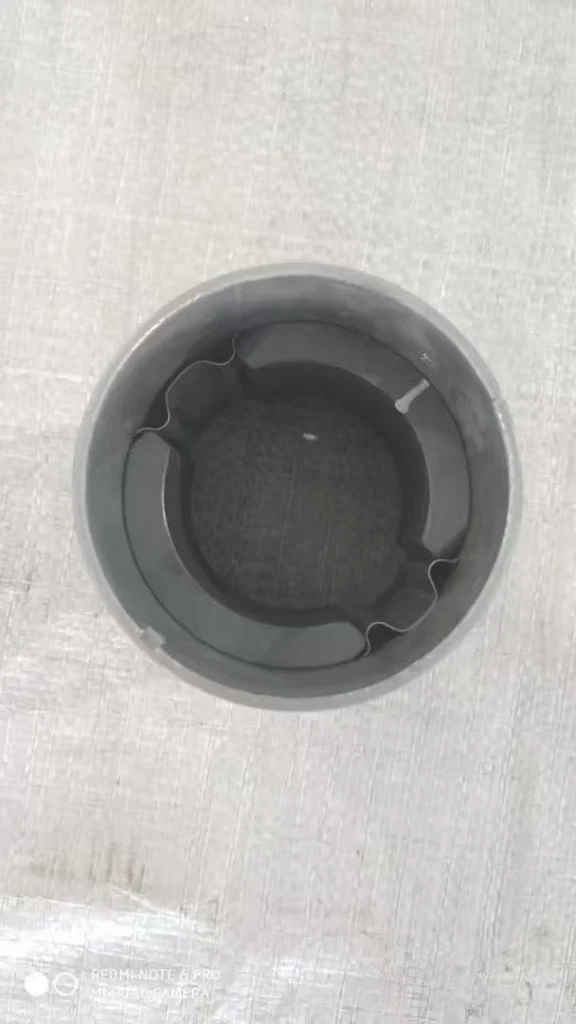
Project Overview
ProfurtherMag supplies ferrite arc magnets to a component manufacturer assembling motor yokes in India. The customer buys the magnets separately and fits two arc segments into each steel yoke with its own equipment; the finished sub-assemblies go downstream for water purifier pump motors. Supply started from the customer’s drawing, and the first samples were approved in the customer’s own yoke assembly rather than on a bench check. Repeat orders have continued since 2017.
The series runs in several arc sizes for different pump motor builds. This page documents one of them — the part the drawing below belongs to — and the dimensions and magnetic values quoted here are the ones this part was produced and supplied to, not a general capability claim.
The requirement on the drawing
The part is a segment of a ring: two of them close the circumference of the yoke, so the radii and the wall are what the assembly depends on, not the overall size.
| Segment | Arc segment, two per steel yoke |
|---|---|
| Outer radius | R35.5 ±0.1 mm |
| Inner radius | R27 +0.2/0 mm |
| Wall | 8.5 −0.1/0 mm |
| Section | 63 ±0.1 mm × 40 ±0.5 mm, as drawn on the face view |
| Radial dimension | 24.6 ±0.5 mm, as drawn |
| Corner breaks | 4-R2 on the face corners, 2-R2 at the ends |
| End detail | 2 × 45° chamfer at the ends, as drawn |
| Grade (as drawn) | Br 380–400 mT, Hcb 230–275 kA/m, Hcj 235–290 kA/m, (BH)max 27–32.5 kJ/m³ |
| Magnetizing direction | Radial, per the drawing |
| Surface | None — supplied uncoated |
| Magnetized state | Supplied unmagnetized as standard; magnetized on request |
| Batch | One full 20GP container |
| Lead time | 30–35 days |
Two dimensions on that drawing are worth reading twice. R27 is given +0.2/0 and the 8.5 mm wall −0.1/0: both one-sided, and both pointing the same way. The bore may open by up to 0.2 mm and the wall may come in by up to 0.1 mm, but neither may go the other way — there is no tolerance into the rotor space. That bias is not arbitrary. It says which side of the part the clearance lives on, and it is the kind of decision an assembly drawing carries that a plain magnet drawing usually does not.
What the sample had to prove
The magnet drawing alone cannot close a project like this. Each yoke takes two segments, seated against the steel bore and held by the customer’s own tooling, and the pair has to close the same circumference without a step at the joints or interference against the rotor. Whether a sample is right is therefore settled at the second part, in the customer’s fixture — not on the magnet measured by itself.
Samples went to the customer for exactly that check. The first arc magnets assembled in the yoke without problems, the customer confirmed it, and bulk purchasing followed that confirmation. Supply has continued since 2017 through repeat orders, and the series has since extended to more arc sizes for other pump motor builds.
How the parts are accepted
Acceptance on this part runs on the assembly, not on a separate inspection routine: the customer fits the pair into the yoke and judges whether it assembles correctly. That is a different gate from the drawing, and both are needed. The drawing’s tolerances are what production is held to; the assembly is what decides whether a shipment is accepted. A part that sits inside every dimension on the drawing is not automatically an accepted part — which is exactly why the sample stage above carries as much weight as the drawing does.
The commercial frame follows the same logic: batches ship as one full 20GP container, with 30–35 days of lead time.
Why the parts ship uncoated and unmagnetized
Both are stated on the drawing and both move work to the customer’s line, so they are worth being explicit about. Uncoated means there is no coating to chip or to specify, and corrosion protection — to whatever extent the application needs it — belongs to the yoke assembly rather than to the magnet. Unmagnetized means the parts can be handled, stored and pressed into the yoke without magnetic attraction pulling ferrous debris onto them, and magnetization happens at the point in the process where the assembly wants it. Where a build prefers to receive the segments already magnetized, that is supplied as well.
Where to read the geometry next
What the five dimensions of an arc segment are and where they go wrong is described on arc segment magnets; the production route behind this part is on wet-pressed ferrite, and the pole patterns that apply to a radial segment are set out separately.
1. The Engineering Challenge
Customer Problem2. Technical Assessment & Root Cause Analysis
Investigation3. Actions Executed by ProfurtherMag
Execution2. Supplied the samples uncoated and unmagnetized, so that fit in the yoke could be judged before magnetization.
3. The customer assembled two segments per yoke in its own tooling and confirmed that the first samples assembled without problems.
4. Supplied bulk orders after that confirmation. Repeat orders have continued since 2017, and the series has extended to several arc sizes, with batch lead times of 30-35 days.
4. Project Outcome & Serial Results
Recorded ResultPractical Takeaway
Sample approval was tied to the customer's own yoke assembly, not to the magnet drawing alone, and the drawing's one-sided tolerances on the bore and the wall were what said where the clearance sits. Both are worth more than the nominal dimensions when a segment is judged.
Supporting Documents
Evidence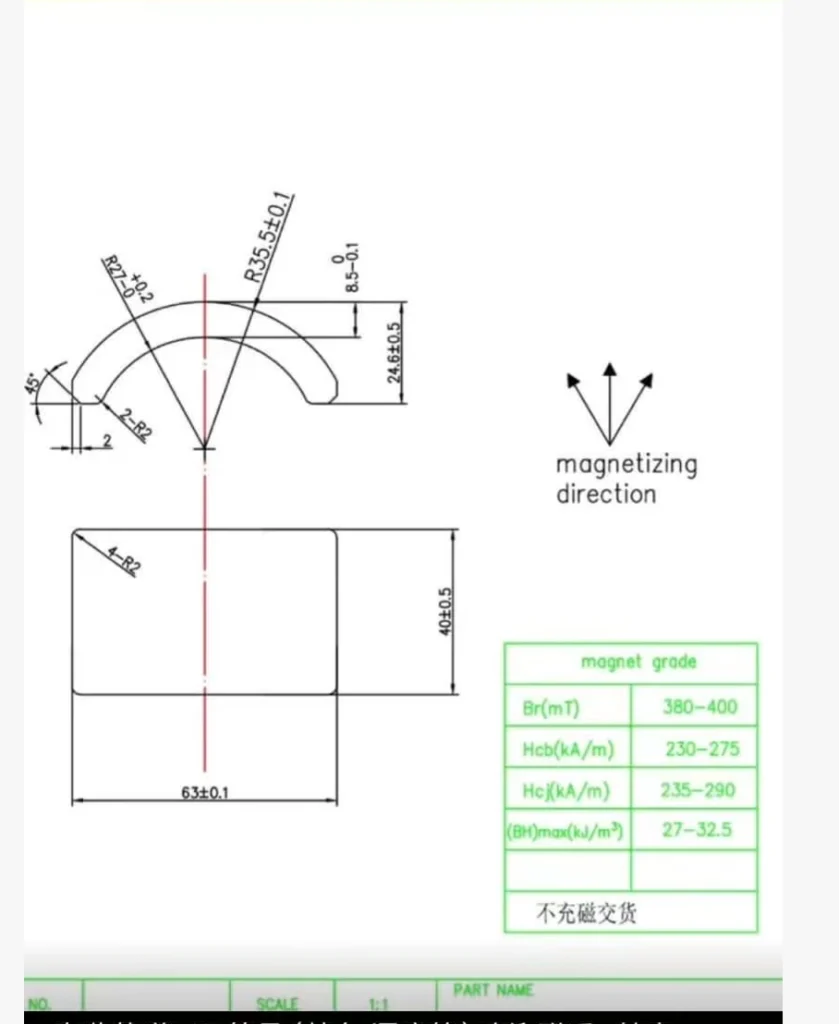
The drawing this part was produced and supplied to: outer R35.5 ±0.1, inner R27 +0.2/0, wall 8.5 −0.1/0, section 63 ±0.1 × 40 ±0.5, corner breaks 4-R2 and 2-R2, grade Br 380–400 mT / Hcb 230–275 / Hcj 235–290 kA/m / (BH)max 27–32.5 kJ/m³, supplied unmagnetized. The series runs several arc sizes to drawings of this form.
Related Records
This project record is filed against the pages below. Each one opens its own record, where the material, application or route is described in full.
This project is also listed under For Component Manufacturers & Assembly Suppliers on the Applications page, where component manufacturers and assembly suppliers can start from a magnet drawing or a sample.
Need Arc Segments for a Pump Motor Yoke?
Send the drawing or a sample and say how many segments go into the assembly. Where two or more segments close the same circumference, the fit between them is part of the review, not a detail after it.