Compression Molded NdFeB
Rapidly quenched NdFeB powder in an epoxy matrix, compression molded into thin-wall rings and arcs. Remanence is below sintered; the gain is in shape.
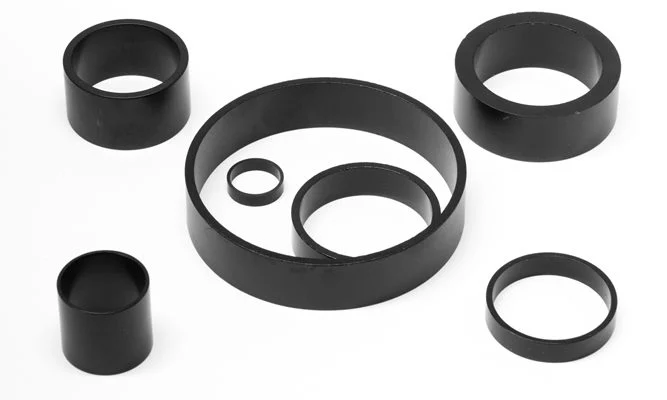
Compression Molded NdFeB is produced from rapidly quenched NdFeB powder compounded with epoxy resin and compression molded into thin-walled rings, arc segments or more complex blocks. It is one of the manufacturing routes within the bonded NdFeB magnet family. This page presents isotropic compression-molded NdFeB materials. Because the powder carries its own magnetic behaviour and the resin holds the shape, the part is formed close to final geometry, and the magnetizing pattern is applied after molding rather than fixed by pressing orientation.
How the part is formed
- Rapidly quenched NdFeB powder is compounded with epoxy resin into a moulding compound, not a slurry and not a thermoplastic pellet.
- That compound is compression molded in a tool that carries the near-final profile, which is how thin-walled rings and arcs are shaped instead of being machined from a solid blank.
- The resin holds the shape once cured, so the part leaves the tool close to final geometry; any grinding step is confirmed on the drawing.
- Magnetization is applied after molding, so the direction is not fixed by the tool.
Spindle motors for optical drives, office automation equipment and stepping motors are the duties this route is specified for; the application guidance sits in Electric Motors & Drives.
ProfurtherMag does not operate its own magnet factory: production runs at screened partner factories, while ProfurtherMag owns the technical judgement, factory matching, sampling and delivery follow-up.
Compression Molded NdFeB Reference Data
The values below are reproduced from the compression molded reference table for this route. They apply to the listed compression molded grades only; sintered and injection molded NdFeB are specified separately.
Magnetic Properties
| Grade | Br (mT) | Hcb (kA/m) | Hcj (kA/m) | (BH)max (kJ/m³) |
|---|---|---|---|---|
| PMC-1 | 300-400 | 200-280 | 400-560 | 24-32 |
| PMC-2 | 400-500 | 240-320 | 480-640 | 32-40 |
| PMC-3 | 500-550 | 280-360 | 480-640 | 40-48 |
| PMC-4 | 550-600 | 320-400 | 560-720 | 48-60 |
| PMC-5 | 590-640 | 360-440 | 560-720 | 56-64 |
| PMC-6 | 630-680 | 400-480 | 640-800 | 64-76 |
| PMC-7 | 650-700 | 400-480 | 640-800 | 68-76 |
| PMC-8 | 680-730 | 400-480 | 640-800 | 76-84 |
| PMC-9 | 700-750 | 440-520 | 720-800 | 80-88 |
| PMC-10 | 720-770 | 440-520 | 720-800 | 88-96 |
| PMC-11 | 750-800 | 400-480 | 480-640 | 88-96 |
| PMC-12 | 760-830 | 400-480 | 480-640 | 88-104 |
| PMC-13 | 640-700 | 400-480 | 880-1120 | 68-80 |
Physical Properties
| Grade | Density (g/cm³) | Recoil permeability | Br coefficient (%/°C) | Operating temp. (°C) | Magnetizing field (kA/m) | Magnetizing field (kOe) |
|---|---|---|---|---|---|---|
| PMC-1 | 5.5-6.0 | 1.2 | -0.24 | 100-120 | >1200 | >15 |
| PMC-2 | 5.5-6.0 | 1.2 | -0.24 | 100-120 | >1200 | >15 |
| PMC-3 | 5.5-6.0 | 1.2 | -0.24 | 100-120 | >1200 | >15 |
| PMC-4 | 5.5-6.1 | 1.2 | -0.18 | 110-130 | >1600 | >20 |
| PMC-5 | 5.6-6.2 | 1.2 | -0.18 | 120-130 | >1600 | >20 |
| PMC-6 | 5.8-6.2 | 1.2 | -0.12 | 120-130 | >1600 | >20 |
| PMC-7 | 5.8-6.2 | 1.2 | -0.12 | 120-130 | >1600 | >20 |
| PMC-8 | 5.8-6.2 | 1.2 | -0.10 | 120-130 | >1600 | >20 |
| PMC-9 | 5.8-6.2 | 1.2 | -0.10 | 120-130 | >1600 | >20 |
| PMC-10 | 5.9-6.2 | 1.2 | -0.10 | 120-130 | >1600 | >20 |
| PMC-11 | 6.0-6.2 | 1.22 | -0.12 | 100-120 | >1600 | >20 |
| PMC-12 | 6.0-6.4 | 1.22 | -0.12 | 100-120 | >1600 | >20 |
| PMC-13 | 5.8-6.2 | 1.15 | -0.10 | 140-160 | >2000 | >25 |
Values are material grade specifications for reference, not a batch test certificate. Operating temperature is listed per grade and is still confirmed against the magnet temperature and magnetic circuit in the application.
Core Process Characteristics
The material this route works in, the advantage that decides it, the limitation to plan around, and the parts it is normally specified for.
| Primary Material | Neodymium (NdFeB) Rare Earth Magnets |
|---|---|
| Core Advantage |
|
| Key Limitation |
|
| Typical Applications |
|
Process Characteristics
The parameters recorded for this route, each with the note that says how it is confirmed on a project.
| Primary Material | Rapidly quenched NdFeB powder with epoxy resin binder The resin holds the shape; the powder supplies the magnetic behaviour. |
|---|---|
| Forming Method | Compression molding of compounded powder Part is formed close to final geometry. |
| Magnetic Isotropy | Isotropic (materials presented on this page) Magnetization direction is flexible rather than locked to the pressing axis. |
| Magnetic Performance | Lower remanence than sintered NdFeB The polymer binder dilutes the magnetic volume fraction. |
| Operating Temperature (Reference) | 100–160 °C across the listed grades; see the grade-specific ranges Actual operating suitability is confirmed for the selected grade, binder system, magnetic circuit and application. |
| Typical Shapes | Thin-walled rings, arc segments, complex blocks Net-shape tolerances and any post-grinding are confirmed on the drawing. |
| Magnetization Options | Multipole and skewed multipole patterns Suited to sensor and encoder duty. |
| Surface Treatment | Confirmed for the material and the environment Surface protection is selected according to the material, corrosion exposure and assembly requirements. |
Technical Documents
-
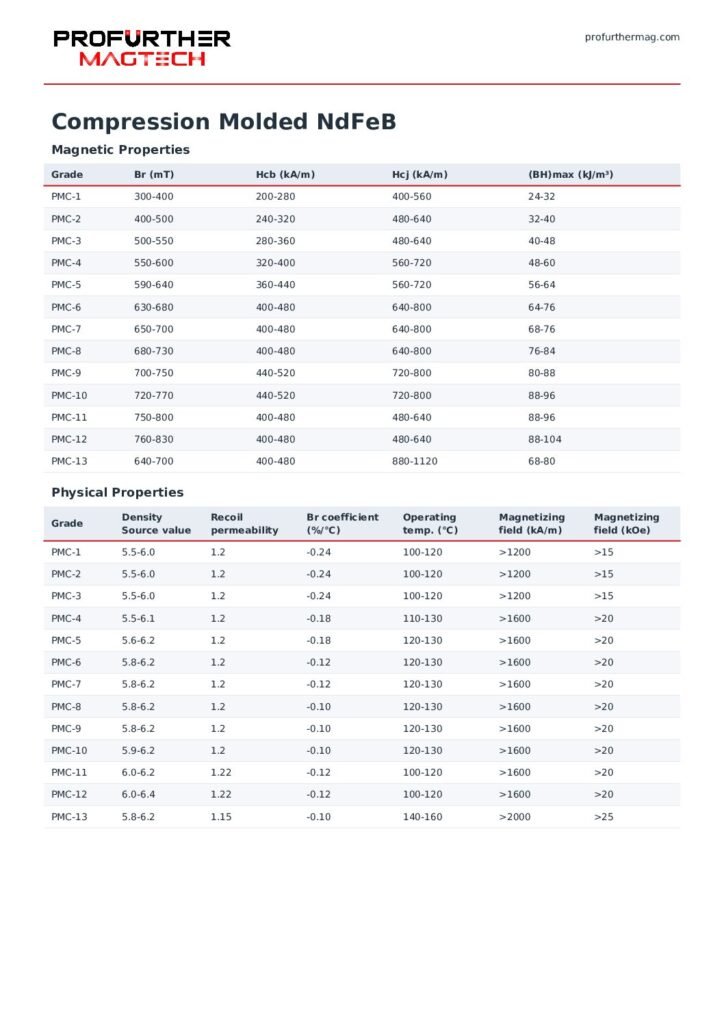 Compression Molded NdFeB Reference (PDF) PMC-1 to PMC-13 compression molded grades, magnetic and physical properties side by side: Br 300–830 mT, Hcb 200–520 kA/m, Hcj 400–1120 kA/m and (BH)max 24–104 kJ/m³, with density 5.5–6.4 g/cm³ and a per-grade operating temperature of 100–160 °C. The same two tables are printed on this page; the file is the version to attach to a drawing pack or send to a colleague. Grade specifications, not a batch test certificate.Select the preview to open the document in a new tab.
Magnetization on This Route
Orientation and magnetization are not the same step: orientation is set while the part is formed or compacted, magnetization is applied afterwards, and what a part can take depends on the material, the tooling and the geometry. Describe the direction, the pole pattern and the face the poles have to sit on — or send the part or its drawing and we will read it with you.
Magnetization feasibility depends on the material, manufacturing process, geometry and required pole pattern. Send us your drawing, sample or magnetization diagram for evaluation.
Explore Magnetization Directions & Pole Patterns → · Magnetization directions and pole patterns explained → · Send the drawing or a sample →
Explore the material overview and compare the available manufacturing routes:
Geometries whose own page names this route. A shape that is not listed does not name this route yet, which says the route is not stated for it - not that the geometry cannot be made this way.
Technical notes and selection articles that reference this route.
- How to Specify Magnetization on a Drawing Technical Guide
How to describe magnetization …
Planning a Part on This Route?
Send the drawing, the sample or the operating conditions you work from. We review the route against the part and answer with the tooling, tolerance and feasibility questions it raises.